
INFORMS Annual Meeting 2026 San Francisco, USA

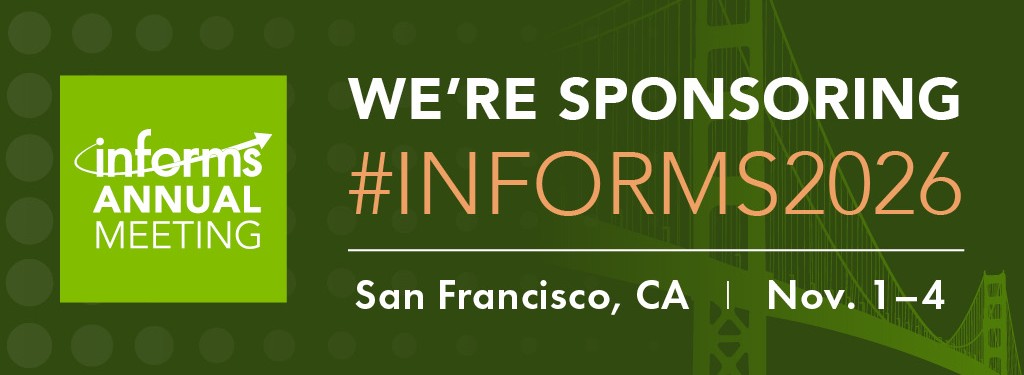
Hexaly is proud to participate as a Diamond Sponsor of the 2026 INFORMS Annual Meeting, taking place November 1–4, 2026, in San Francisco, USA.
Organized by the Institute for Operations Research and the Management Sciences (INFORMS), the Annual Meeting brings together researchers, academics, students, and industry professionals from around the world to share the latest developments in Operations Research, analytics, and decision science.
The 2026 meeting will take place at Moscone Center South and the San Francisco Marriott Marquis. The program will feature plenary talks, keynotes, technical sessions, tutorials, networking opportunities, and an exhibition bringing together leading organizations in the field.
As a Diamond Sponsor, Hexaly looks forward to connecting with the international Operations Research community and demonstrating how Hexaly Optimizer extends traditional Mixed-Integer Programming (MIP) to solve large-scale, real-world optimization problems.
Meet Hexaly at INFORMS 2026
Visit the Hexaly booth #200 and meet Fred Gardi, Ph.D., Founder & CEO of Hexaly. Whether you work in academia or industry, stop by our booth to discuss your optimization challenges and discover how Hexaly Optimizer can help you model and solve complex optimization problems efficiently.
You’ll also have the opportunity to discover what’s new in Hexaly 15.0, including major performance improvements in routing, scheduling, and packing, as well as advances in nonlinear optimization.
As part of its Diamond Sponsorship, Hexaly will host two presentations during the event.
Exhibitor Workshop
Hexaly, beyond traditional MIP
Fred Gardi, Ph.D., Founder & CEO, Hexaly
Saturday, October 31, 2026, 3:00 PM – 4:15 PM
Mixed-Integer Programming (MIP) has been the dominant optimization framework in Operations Research for several decades. While highly effective, classical MIP formulations can become increasingly difficult to express and solve as problems grow in scale and structural complexity, particularly in domains such as routing, scheduling, and packing.
Hexaly is a next-generation optimization solver designed to extend the scope of traditional MIP. Rather than relying solely on linearization and standard branch-and-bound workflows, it provides a unified framework for modeling and solving combinatorial and nonlinear problems in a more natural way. By integrating techniques from MIP, constraint programming, nonlinear optimization, and black-box optimization within a single engine, Hexaly enables more expressive models while maintaining high solution quality and scalable performance.
In this talk, I will present the key principles behind this approach, with a focus on large-scale discrete optimization problems where Hexaly performs best, such as routing, scheduling, and packing. I will show how this extended modeling framework enables problems to be formulated more closely to their underlying structure, while allowing diverse algorithmic components to interact in a complementary manner. Finally, I will present selected benchmark results illustrating the practical impact of this approach.
Technology Showcase
From Compact Combinatorial Models to Strong Dual Bounds: Automatic Decomposition in Practice
Fred Gardi, Ph.D., Founder & CEO, Hexaly
Monday, November 2, 2026, 11:00 – 11:35 AM
Many combinatorial problems in routing, scheduling, and packing are most naturally expressed with set and permutation variables. In a vehicle routing problem, for instance, the sequence of visits of each vehicle is a single list variable. Such compact models are easy to write and well suited to finding good solutions, but they raise a fundamental question: how can strong dual bounds be derived from them? A direct MILP reformulation introduces a quadratic number of binary variables and big-M constraints, which yields weak linear relaxations and scales poorly.
This tutorial-style session explains how extended formulations close this gap. We first review why compact MILP formulations of sequencing problems are weak, and how Dantzig-Wolfe-type extended formulations over routes, schedules, or patterns provide much tighter relaxations. We then discuss how the required structures can be detected automatically in a compact model, and how the resulting formulation can be solved with branch-and-cut-and-price, column elimination, and no-good search, so that the modeler does not need to design the decomposition by hand.
We illustrate these ideas with three case studies drawn from our implementation in the Hexaly solver: capacitated vehicle routing on the CVRPLib X instances (up to 1,000 customers, average gap of 4.5% in 10 minutes), flexible job shop scheduling (average gap of 2.9% in 1 minute), and open-pit mine planning on MineLib (up to 112,000 items and 3 million precedences, with all Ultimate Pit Limit instances solved to optimality in under 10 seconds and gaps below 4.8% in 10 minutes for the Constrained Pit Limit). For each case, we highlight which modeling choices drive bound quality and computational performance. We conclude with practical lessons for practitioners and open research questions in automatic decomposition.
We look forward to meeting the INFORMS community in San Francisco!
Explore upcoming conferences, events, and webinars to see where the Hexaly team will appear next.
Ready to start?
Discover the ease of use and performance of Hexaly through
a free 1-month trial, or enjoy free academic access.