
OR 2025 Bielefeld


Hexaly is delighted to be the Gold Sponsor of OR 2025, the International Conference on Operations Research, organized by the German Operations Research Society (GOR). The event will occur from September 2 to 5, 2025, at Bielefeld University, Germany. The OR 2025 conference program is available here.
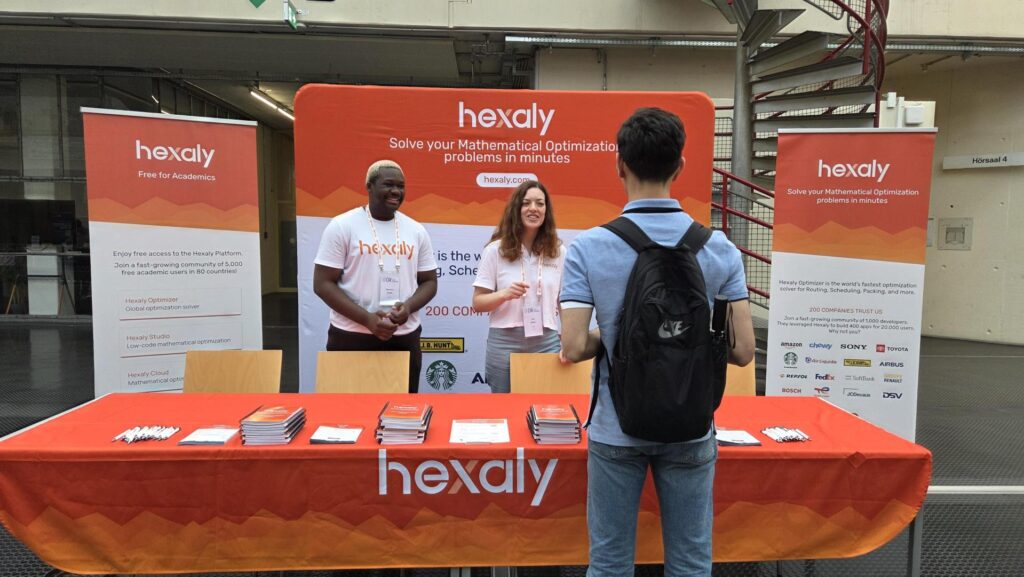
Come by the Hexaly booth at OR 2025 to meet our optimization scientists and discover the new release Hexaly 14.0 and its dramatic performance improvements for solving Routing, Scheduling, Packing, and many other problems in Supply Chain and Workforce Optimization. This is also the opportunity to explore and discuss our numerous job offers.
Hexaly, a new kind of optimization solver
Léa Blaise
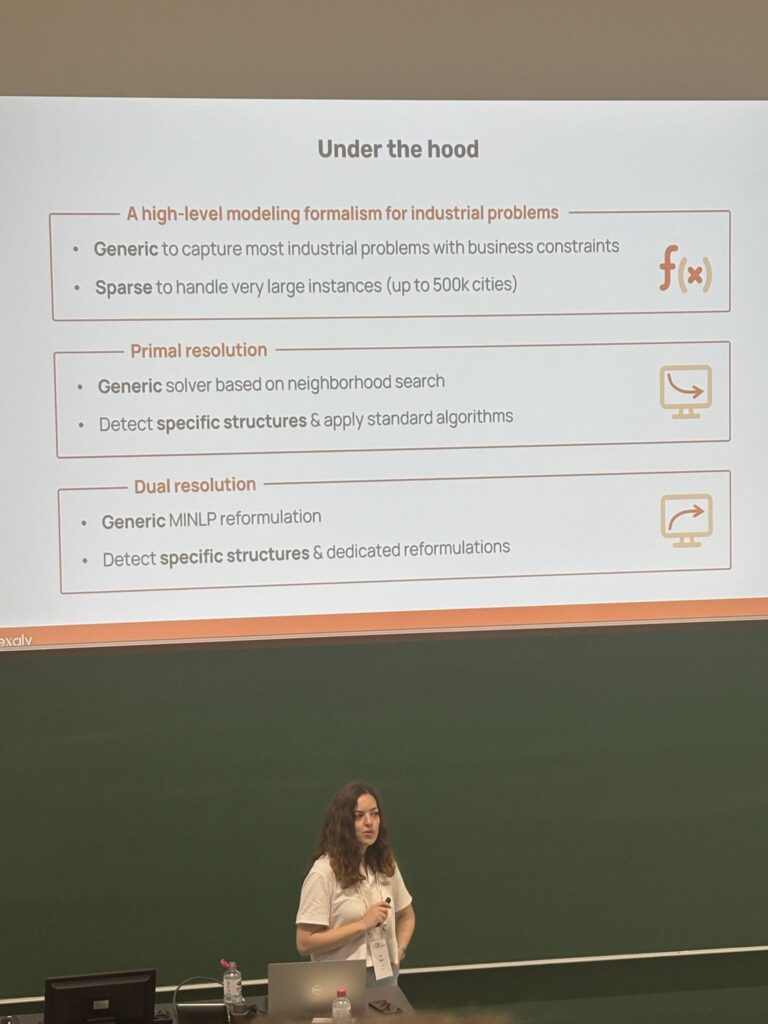
Friday, September 05, 10h45-11h30 – Room H15
Hexaly Optimizer is a new kind of global optimization solver. Its modeling interface is nonlinear and set-oriented. In a sense, Hexaly APIs unify and extend modeling concepts from mixed-linear programming, nonlinear programming, and constraint programming. Under the hood, Hexaly combines various exact and heuristic optimization methods, such as branch-and-bound, automatic Dantzig-Wolfe reformulation, column and row generation, propagation methods, local search, direct search, and surrogate modeling techniques.
Regarding performance benchmarks, Hexaly distinguishes itself against the leading solvers in the market, like Gurobi, IBM Cplex, and Google OR Tools, by delivering fast and scalable solutions to Routing, Scheduling, Packing, Clustering, and Location problems.
This talk will introduce our set-based modeling formalism and show its scalability for large instances. We will then explore how the solver can use this formalism to automatically use state-of-the-art resolution techniques from the exact and heuristic fields.
Convexity detection in Hexaly
Michael Feldmeier
Wednesday, September 03, 10h45-12h15 – Room H15
Hexaly is a mathematical optimization solver based on various operations research techniques, combining both exact and approximate methods such as linear programming, non-linear programming, constrained programming and primal heuristics. Knowing model features and recognizing special cases is imperative to selecting the right methods for solving the problem as fast as possible. One such model feature is convexity. Recognizing a convex model as such allows selecting more efficient algorithms under Hexaly’s hood. In this talk we will present how Hexaly determines a user model’s convexity. Convexity analysis typically examines the expression tree of the continuous relaxation of the model constraint by constraint. Combining knowledge of convexity-preserving operations with known properties of basic functions allows evaluating the curvature of complicated constraints and objectives. This can be straightforward to compute, e.g. positive sums of convex functions are convex. However, already for quadratic programmes convexity detection by this method can be ineffective: depending on the formulation of the functions as well as how they are translated into the expression tree it may not be possible to determine a convex problem as such. Of course, in the case of quadratic programming, spectral analysis can be applied. However, this is computationally expensive, and can sometimes be avoided, e.g. by application of Gershgorin’s circle theorem. We will present data from numerical experiments about the reliability of our implementation of convexity detection in Hexaly.
Optimization of Workforce Planning in Daycare Centers: Balancing Operational Needs and Legal Requirements
Bienvenu Bambi, Emeline Tenaud
Thursday, September 04, 14h30-16h00 – Room H5
This talk presents an industrial application for workforce planning in a network of daycare centers and animal care facilities. The schedules are optimized for a week and aim to plan the activities of several hundred employees, considering about ten different functions. Each employee has specific availability constraints, work hour limits, and role qualifications. The demand for each function is determined by legal requirements regarding staff-to-child ratios and operational needs.
The problem is modeled with boolean decision variables representing employee-shift assignments, where shifts are generated based on minimum/maximum durations and time increments. The optimization model minimizes understaffing and overstaffing while respecting all operational constraints (legal requirements, employee work hour limits, and specific scheduling rules).
This highly combinatorial optimization problem has been efficiently solved using Hexaly, a global optimization solver combining exact and heuristic methods. The solver provides optimal solutions within minutes for real-world instances. Based on this optimization model, a web application has been developed. A demonstration of this application will be presented during the talk.
Hexaly Workshop: Modeling and solving packing problems with Hexaly Studio
Léa Blaise
Tuesday, September 02, 14h30-16h00 – Room H15
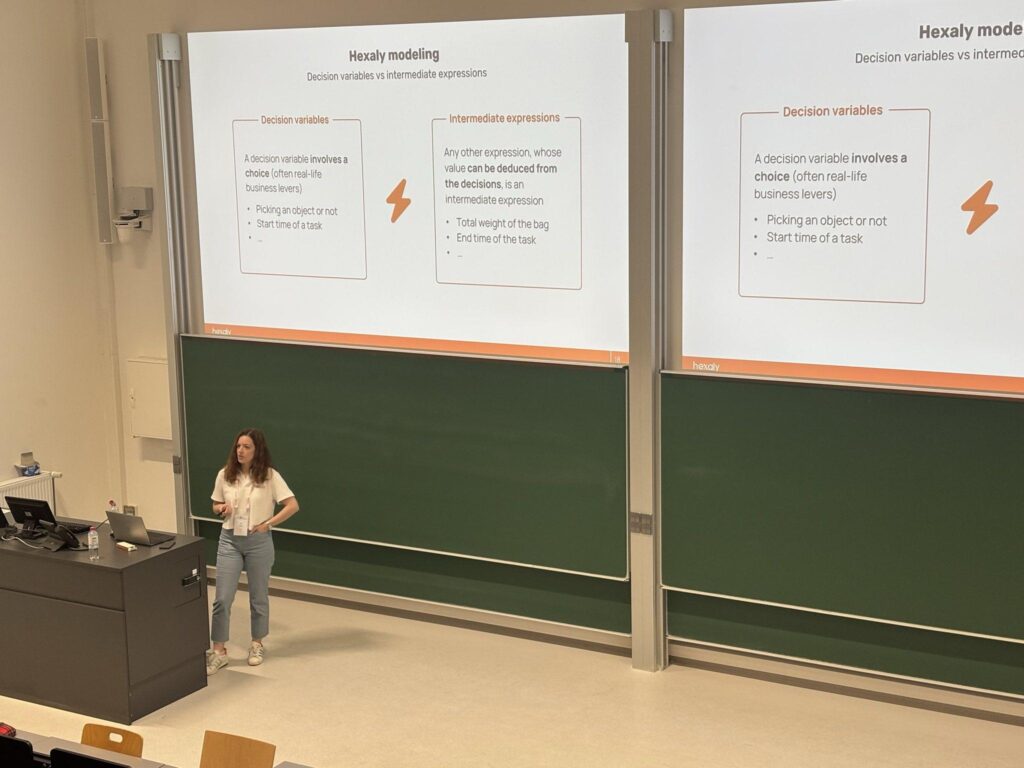
Hexaly Optimizer is a global mathematical solver that integrates both exact and heuristic techniques to tackle complex optimization problems. At its core is an innovative modeling formalism based on nonlinear and set-oriented expressions, enabling users to write compact, expressive models for a wide variety of optimization problems. This formalism not only simplifies the modeling process but also provides the solver with higher-level structural information, allowing it to leverage advanced algorithmic techniques from the literature to obtain state-of-the-art performance on classic optimization domains such as routing, scheduling, and packing.
In this hands-on workshop, we will focus on the application of Hexaly to packing problems, showcasing how the solver’s set-based modeling capabilities naturally align with the structure of these problems. Participants will be guided through building and solving real-world packing problems using Hexaly Studio, a web-based integrated development environment designed specifically for optimization modeling. Hexaly Studio features intuitive dashboards, interactive widgets, and graphical solution visualizations, making it easy to both formulate models and interpret results. Through guided examples and interactive problem-solving, participants will gain hands-on experience with Hexaly and will be equipped to explore it further in their own research or applied projects.
We look forward to connecting with the operations research community at OR 2025 in Bielefeld.
Ready to start?
Discover the ease of use and performance of Hexaly through
a free 1-month trial, or enjoy free academic access.